Remote Release Mechanism
ESP32-based wireless cage release system. Multiple units form a mesh network, all controllable from a single web app hosted on the board itself. Custom PCB, battery-powered with USB-C charging, 3D printed enclosure. No cloud, no phone app required.
project snapshot
enclosure
about this build
The brief was simple: release multiple cages remotely across a large area, with all units controllable from one place. The solution uses ESP32 C3 Dev boards in a mesh network: each node hosts its own web interface, and the network handles routing between them. Range scales with node density, not a single radio link.
Each unit is fully self-contained: battery-powered with USB-C charging, a boost converter to maintain a clean 5V rail, battery voltage monitoring, a servo to actuate the release, and a status LED. The enclosure is 3D printed in PETG and designed to be field-serviceable. A custom PCB ties everything together cleanly: no rat's nest, no hot glue.
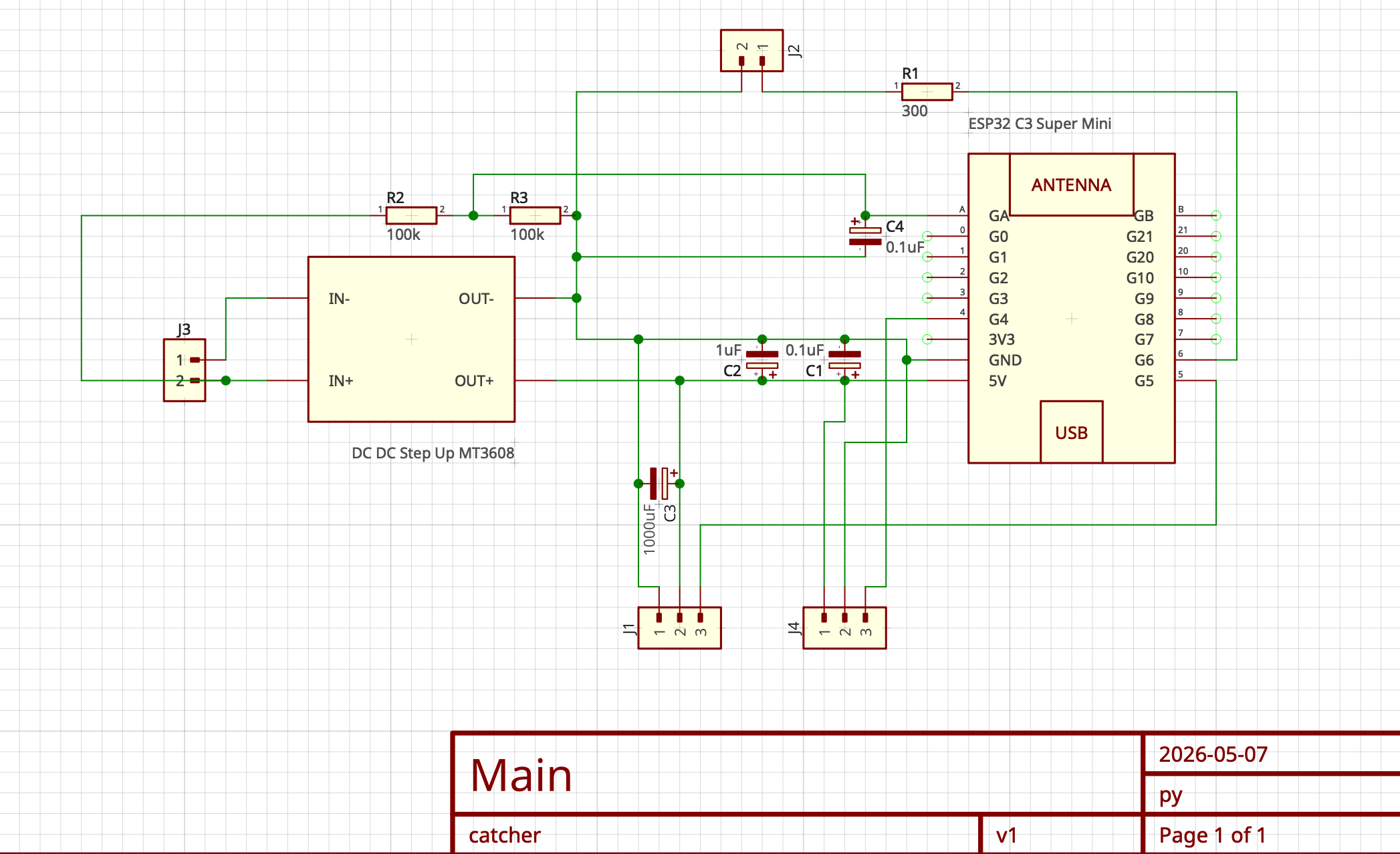
circuit
Power path: 3.7V Li-ion → TP4056 (USB-C charging) → MT3608 boost → 5V rail. A 0.1µF + 1µF decoupling pair filters switching noise on the 5V line. A voltage divider on A0 steps battery voltage down to a safe ADC range for monitoring (with 0.1µF noise cap). G6: power LED. G5: servo. A 1500µF bulk cap prevents voltage droop under servo load.